


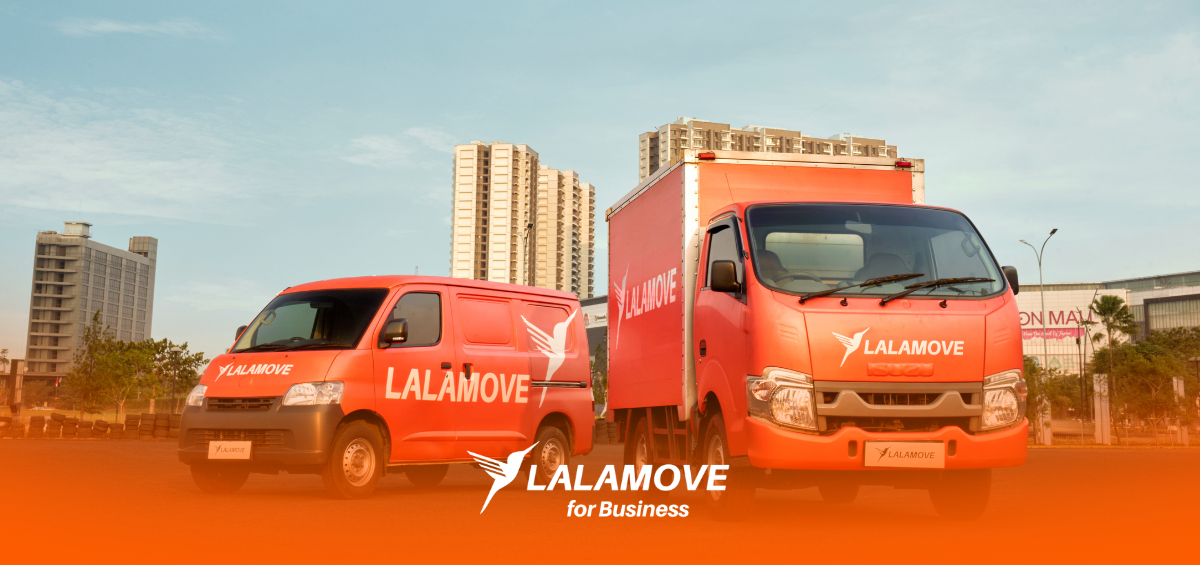
Lalamove l300 delivery and heavy truck at a warehouse bay, illustrating how businesses choose the right delivery vehicle.
Choosing the Right Delivery Vehicle for Different Business Needs
Retail, food and beverage, and manufacturing businesses don’t move the same kinds of goods, so they don’t need the same delivery vehicle for every trip.
A retail business may need only a motorcycle or sedan for single customer orders and a larger one for branch inventory restocking. An F&B business may move ingredients, equipment, or bulk orders between nearby cities or provinces. A manufacturer may need to transfer raw materials or finished goods between facilities and warehouses.
The challenge isn’t finding one vehicle that can do everything; it’s choosing the right vehicle for each delivery without complicating logistics or unnecessarily increasing operational expenses.
Weight is a good place to start, but it isn't the whole decision. The space the goods take up, the number of stops, the route and access conditions, the required protection, and the delivery deadline can all affect which vehicle makes sense.
For businesses with different delivery needs, a delivery vehicle guide can help them choose from multiple vehicle types instead of maintaining a fleet for every possible scenario.
What Should I Consider When Choosing a Delivery Vehicle?
Choosing the right vehicle depends on what your business delivery actually requires. Before booking, consider five things:
-
What are you delivering?
-
How many stops do you have?
-
Can the vehicle reach the destination?
-
Do the goods need special protection?
-
When does it need to arrive?
What are you delivering?
Start with both weight and size. A light but bulky shipment may need a larger vehicle because it takes up more space, while dense goods may reach the weight limit first.
For example, a 1,000 kg cargo van may be suitable for some business deliveries, while a 2,000 kg van or larger truck may be more appropriate for heavier shipments or those that take up more space. The key is to check both the load's weight and volume.
How many stops do you have?
A single large delivery and a multi-stop run have different requirements, which mostly depend on the nature of the business.
If several nearby branches or customers can receive their goods within the same delivery window, consolidating compatible stops can reduce the number of trips. But if one order needs to arrive at a specific time, it may make more sense to send it separately rather than have it wait behind other stops.
Can the vehicle reach the destination?
The largest vehicle isn't always the most practical choice, especially when routes lead to dense urban areas.
Before booking, consider factors such as route, street access, loading area, clearance, and any vehicle restrictions that apply to the destination. A vehicle with enough capacity is only useful if it can reach the delivery point.
Pro Business Tip: City-specific truck bans can quickly derail a delivery schedule if not planned for in advance. Before booking heavy business transport, review the local traffic regulations for both your pickup point and destination. Sharing these route restrictions with your driver ahead of time helps them select compliant vehicle classes, choose alternate routes, or adjust drop-off windows to keep shipments arriving on schedule without unexpected stops.
Do the goods need special protection?
Consider what the goods need during transit. Proper packaging and an appropriate vehicle can help protect products from movement, rain, dust, and other road conditions.
For temperature-sensitive goods, businesses should pack items properly for transport, book an appropriate vehicle, choose a delivery option that matches the required timing, and inform the driver about the nature of the shipment.
When does it need to arrive?
Finally, consider the delivery window.
A branch waiting for inventory, an F&B outlet running low on supplies, and a manufacturer waiting for a component may have very different timing requirements. For deliveries that need to arrive sooner, businesses can consider Priority delivery where available and appropriate for the shipment.
The goal isn't to choose the biggest vehicle available. It's to choose the vehicle that can complete the job without paying for capacity you don't need.
How Delivery Needs Differ Across Industries
The right vehicle depends on what your business delivers and where those goods need to go.
Retail
Retail businesses may handle several types of deliveries in a single day, from small customer orders to branch replenishment and larger inventory transfers.
A motorcycle or sedan may work for smaller orders or documents, while a 1,000 kg or 2,000 kg van can support larger stock movements. Heavier or bulkier transfers may require a truck, depending on the load and route.
Food & Beverage (F&B)
F&B businesses often need to move ingredients, packaging, equipment, and orders between suppliers, kitchens, stores, and customers.
A smaller vehicle may be enough for lighter supplies or individual orders, while vans and trucks can support larger replenishment runs, catering orders, or equipment movement. Chilled and frozen items are the exception: those belong with a cold-chain carrier, not a standard van.
Manufacturing
Manufacturers typically move goods at several points in the supply chain, from raw materials and components to finished products.
A 2,000 kg van may suit smaller transfers, while 3,000 kg, 5,000 kg, 7,000 kg, or 12,000 kg trucks can support larger movements when the load, route, and receiving location require more capacity.
These are only starting points. Delivery requirements can vary from one run to another, so access to different vehicle types can give businesses more flexibility.
Van or Truck: Which One Makes More Sense?
The choice between a van and a delivery truck depends on the delivery requirements, not just the weight of the goods.
A 1,000 kg or 2,000 kg van can make sense for city distribution, branch replenishment, customer orders, and multi-stop deliveries. It can be more practical when the route involves smaller drops and tighter streets.
A 3,000 kg, 7,000 kg, or 12,000 kg truck can be more suitable for larger or heavier shipments, particularly for transfers between warehouses, facilities, distribution points, or other locations equipped to receive larger loads.
The same business may need both, and here’s why:
-
Retailers – Might use a smaller vehicle for customer orders and a larger vehicle for branch transfers.
-
F&B business – May prefer booking a van to replenish several locations and a delivery truck for a larger equipment or supply movement.
-
Manufacturer – Most deliveries require different vehicle sizes, depending on whether you're moving components, finished goods, or larger loads between facilities.
The question isn't “Which vehicle is best?” It's “Which vehicle is best for this delivery?”
Does Your Business Need to Own Every Delivery Vehicle?
If your business handles different types of deliveries, owning a vehicle for every requirement can be difficult to justify. Some vehicles may only be needed during peak periods, bulk transfers, or unexpected increases in demand.
Instead, businesses can combine their existing fleet with on-demand delivery capacity, adding vehicles when needed without expanding their own fleet.
Through a corporate account, Lalamove gives businesses access to multiple vehicle types, from motorcycles and sedans to 1,000 kg and 2,000 kg vans and larger delivery trucks, depending on availability and service area. A delivery vehicle guide helps businesses choose the right vehicle based on each shipment's size, weight, and requirements.
This makes it easier to scale delivery capacity as business needs change, without having to own every vehicle you might need.
What changes when you manage deliveries through one business account?
As delivery volume grows, businesses also need a simpler way to manage bookings, users, tracking, and costs. A business account can give teams a central place to manage deliveries instead of having different employees or branches handle bookings independently.
Lalamove's business account supports shared access, delivery tracking, centralized payment and billing records, and other tools designed for business operations. Businesses with higher order volumes can also explore API automation and e-commerce integrations to reduce manual order processing.
This lets businesses manage different delivery requirements while keeping bookings and delivery activity in one business setup.
How should businesses handle sensitive goods?
Businesses and delivery providers share responsibility for making sure shipments are properly prepared and handled. That said, businesses should pack goods appropriately, choose a vehicle that fits the load, select the right delivery option, and communicate any special handling requirements to the driver.
This is especially important for chilled, frozen, and other temperature-sensitive goods. An enclosed vehicle protects them from rain, dust, and road exposure, but it does not hold a temperature — goods that must stay chilled or frozen need a cold-chain carrier, and that responsibility sits with the shipper. For time-sensitive shipments, Priority delivery is available where appropriate.
Lalamove business-account deliveries are automatically insured up to ₱75,000 through Pioneer Insurance, subject to policy terms. For eligible high-value shipments, businesses can also opt for Goods Protection Promises, a separate paid program that can extend coverage up to ₱8 million, with pricing and eligibility subject to assessment and its own terms.
Automatic insurance and optional Goods Protection are separate products, and coverage is subject to their respective terms and conditions.
How Can You Make Vehicle Selection Easier?
You don’t need to rethink the vehicle for every delivery from scratch. Start by identifying your business’s most common delivery scenarios:
-
Small customer or branch orders
-
Regular store or outlet restocking
-
Multi-stop deliveries
-
Large or bulk shipments
-
Peak-season or promotional demand
Assign a preferred vehicle type to each recurring scenario as necessary, then define the exceptions that require a different option. This consideration creates a simple delivery playbook for your team while still leaving room to adjust when the load, route, or timing changes.
For businesses using on-demand delivery, it also means matching each booking to the run's actual requirements rather than forcing every delivery into the same vehicle. Lalamove gives businesses a full range of options on one account.
When Should You Use a Different Delivery Setup?
There may be instances when on-demand delivery may not be the right solution for every type of shipment or route.
Specialized requirements may call for a different setup. For example, regulated hazardous goods may require a licensed specialist, while deliveries requiring specialized unloading equipment or an on-site crew may be better handled by a dedicated supplier or logistics provider.
A fixed or contracted fleet can also make more sense for predictable, high-frequency routes where the same vehicle travels the same route every day.
For many businesses, however, the practical answer is a combination: use dedicated capacity where demand is predictable and on-demand delivery when volume changes, additional vehicles are needed, or a delivery falls outside the normal fleet's capacity and location. A delivery vehicle guide can help businesses choose the right vehicle based on each shipment's size, weight, and requirements.
The right logistics setup isn't about choosing one solution for every delivery. It's about having the flexibility to choose the right solution for each one. With Lalamove, every business can choose based on its delivery needs, with a wide fleet range and coverage across designated areas in Luzon and Cebu.
Key Takeaways
|
|||||||
The vehicle decision is easiest to test on the runs that already cause trouble: the bulky load that fills a van early, the multi-stop day, the address with a clearance limit. Open a corporate account or talk to the Lalamove business team
FAQs about Choosing the Right Delivery Vehicle
How do I choose the right delivery vehicle for my business?
It depends on the delivery, not just the type of business, and most businesses run several delivery types. Start with the smallest vehicle that can take the load, reach every drop-off, keep the goods protected, and cover all the stops on time. Weight only rules vehicles out. Four other factors decide among the rest. They are the space the load occupies, the number and order of stops, access at each address, and the protection the goods need.
Should I choose a van or a truck?
Choose a van for city distribution. Vans suit loads under 2,000 kg, narrow streets, and multiple stops at different addresses. Choose a truck for larger or heavier transfers between fixed points such as a plant, a warehouse, or a distribution center, where the receiving end has a bay and equipment to unload. What the delivery needs matters more than weight alone.
Does the weight of the load decide which delivery vehicle to use?
No. Weight sets the minimum and rules out vehicles that cannot take the load. It rarely decides between the remaining vehicles. A load can fill a van before it reaches the rated weight, because the space runs out first. Access at the drop-off, the number of stops, and the protection the goods need decide the rest.
Is one large vehicle with several stops better than several small vehicles?
Usually, when the drops sit close together and each one can wait its turn. A single vehicle covering several drops in one trip lowers the cost per delivery. The trade-off is arrival time. On a consolidated run, the last stop waits behind the earlier ones. Book that drop on its own when its timing cannot move.
What kind of delivery vehicle should I use for goods that must stay dry?
Use an enclosed body. It keeps rain, dust, and road exposure off packaged stock, electronics, cosmetics, and printed material. An enclosed body does not control temperature. Chilled or frozen goods, vaccines, and temperature-sensitive medicines need a carrier that operates a cold chain. Confirm which body types are available on your route, since availability varies by area.
What delivery vehicles does Lalamove offer businesses in the Philippines?
Lalamove gives business accounts on-demand access to motorcycles and sedans. The same account covers 1,000 kg and 2,000 kg vans, and trucks at 3,000, 5,000, 7,000, and 12,000 kg. One corporate account covers first-mile pickup, transfers between facilities, and last-mile delivery. Lalamove serves designated areas across Luzon and Cebu, and vehicle availability varies by location.
Which loads should not be booked through an on-demand delivery platform?
Three kinds of loads belong elsewhere. Loads that need a controlled temperature, such as frozen food and temperature-sensitive medicine. Regulated hazardous goods, which require a licensed specialist carrier. And site deliveries that need unloading equipment and a crew on arrival, such as construction material craned off the deck at an active site.
How does a business book the right vehicle through Lalamove?
A business can open a corporate account on the Lalamove business page and add the staff who need booking access. Each booking sets the vehicle class, the pickup point, and the drop-off point. Teams with higher order volume can place bookings from their own ordering system through an API automation, so the vehicle standard applies automatically.


