


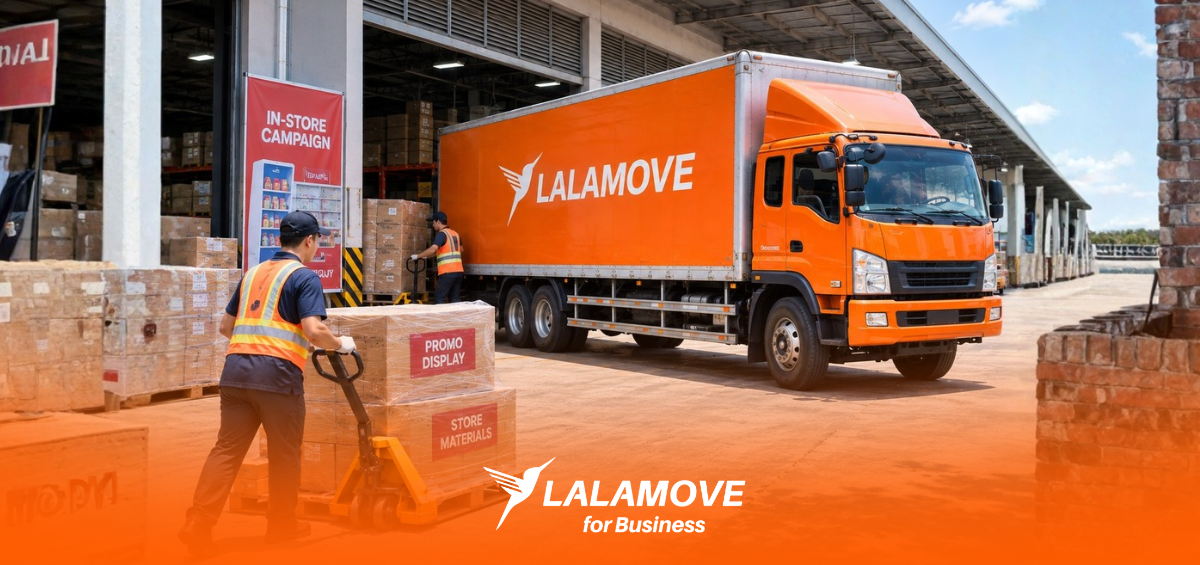
FMCG merchandising materials delivery works best as its own job, planned separately from stock delivery. Many Fast-Moving Consumer Goods (FMCG) brands take a shortcut instead. They send point-of-sale (POS) materials, often shortened to POSM, on the regular stock truck, since it already goes to the same stores. The two do not mix well. The distributor unloads stock into the stockroom on its schedule. Freestanding display units (FSDUs), shelf-talkers, standees, and signage belong on the selling floor before a launch date. Mixed in with cartons, they can sit unopened in the stockroom after the promotion has started.
Retail merchandising logistics fixes this by giving each campaign's in-store promotional materials their own delivery plan, timed to the launch instead of the stock cycle. The risk of mixing is highest at year-end, when stores receive the most stock and a box of displays is easiest to overlook.
What Does FMCG Merchandising Materials Delivery Involve?
When planning FMCG merchandising materials delivery, marketing and trade execution teams must account for fragile items, many store drops, and strict drop-off windows.
What Delivery Arrangements Do In-Store Promotional Campaigns Need?
-
Material Protection & Structural Integrity: POS displays are often made of corrugated board, lightweight metal, wood, or acrylic that can easily crush, bend, warp, or crack during transit. A dented display is often not set up at all, so keep each unit in its box and load it so heavier cargo cannot rest on it.
-
Multi-Stop Distribution: Campaign launches typically involve distributing retail campaign supplies across dozens of locations for the same launch date.. Each stop means unloading around other stores’ sets, which is when materials get scuffed or mixed up. Label each set by store, and load the sets so the first drop sits nearest the door.
-
Time-Sensitive Deliveries: Store managers often strictly enforce off-peak drop-off schedules to keep aisles clear during busy shopping hours. Malls may add their own receiving rules, such as fixed loading-bay hours. A set that misses its window may wait until the next day, so confirm each store’s receiving hours before you plan the routes.
How Can FMCG Brands Coordinate Point-of-Sale Display Delivery for Seasonal and Trade Campaigns?
Seasonal surges, such as year-end holiday promos, back-to-school drives, and quarter-end events, bring higher delivery volumes and tighter retail deadlines. During these peak periods, the plan needs extra flexibility, because store lists and quantities often change close to launch. Trade campaigns, which a brand runs with its retail partners, add another layer: each partner may set its own launch date and display rules.
To keep seamless seasonal display delivery on schedule, FMCG brand teams should follow these steps:
-
Audit and Batch Campaign Assets
Group promotional materials, banners, and POS stands by region or retail branch to simplify routing. Then check each store’s set against the campaign list before it leaves the warehouse, so you catch a missing standee at packing, not at the store.
-
Verify Vehicle Specs & Size Requirements
Match the vehicle to each batch. Flat-packed standees for a few stores may fit a sedan or a 1,000 kg van. Pre-assembled FSDUs for a whole region may need a 3,000 kg truck or larger. Displays usually fill a vehicle’s space before they reach its weight limit, which logistics teams call cubing out, so plan by volume as well as weight. (How to match vehicle size to a load is explained further in choosing the right delivery vehicle for different business needs.)
-
Establish Safe & Trackable Transport
Use delivery tracking so your team can see where each store’s set is and confirm when it arrives. Tracking shows where an item is. It does not protect it. For high-value displays, add goods protection to cover custom marketing investments against loss or damage in transit, subject to its terms.
How Does Lalamove Support Retail Execution for In-Store Campaigns?
Lalamove supports in-store campaign deliveries across designated areas in Luzon and Cebu, with a range of vehicles from motorcycles to 12,000-kg trucks. Businesses can manage deliveries through a single corporate account, with access to features such as multi-stop routing and real-time tracking, as well as mid-mile and last-mile delivery benefits.
Safe, on-time deliveries of marketing materials are key to meeting campaign launch dates and maintaining store compliance, which means each store displays the campaign as planned. With a Lalamove for Business corporate account, FMCG marketing and merchandising teams can book both legs of a rollout. The first mile runs from the display supplier to the brand’s warehouse. The last mile runs from the warehouse to each store.
-
Protection for High-Value Displays
Replacing customized in-store promotional materials is expensive, and a reprint can take longer than the campaign has left.
Deliveries booked through a Lalamove business account are automatically insured up to ₱75,000 through Pioneer Insurance, subject to policy terms. Higher-value shipments can be covered separately through Goods Protection Promises (GPP), an optional paid program offering coverage up to ₱8 million, priced per booking and subject to assessment and its own terms. The two are separate: the ₱75,000 insurance applies automatically, while the higher coverage is purchased per booking. GPP is available to Enterprise-tier accounts, and it is worth adding when one trip carries a whole region’s valuable campaign displays and branded collateral.
-
Vehicles and Routes for Multi-Store Rollouts
Whether moving promotional supplies from a regional distribution hub to retail partners or coordinating multi-location store drops, brands can book the vehicle each batch needs. Vehicle classes include motorcycles and sedans; 1,000 kg and 2,000 kg vans; and trucks at 3,000, 5,000, 7,000, and 12,000 kg. Multi-stop routing combines several store drops into one trip. Vehicle availability varies by location.
-
Simplified Payment & Operational Workflow
Managing multiple invoices across separate delivery bookings during a major trade rollout can burden administrative teams. Bookings on a Lalamove corporate account are listed in a monthly corporate statement, so finance can reconcile a campaign’s deliveries from one record. Enterprise-tier accounts can also use the Postpaid Wallet, which lets the team book throughout the rollout and settle on a fixed monthly billing cycle.
What Should FMCG Brands Plan Beyond the Delivery?
Beyond the delivery, FMCG brands still need to plan two things: display setup and coverage. Lalamove delivers the materials to the store, but your merchandisers or the store team assemble and set up each display, so schedule them to arrive when the set does. Service covers designated areas across Luzon and Cebu, so stores in other regions need a separate delivery arrangement.
Streamline Your Next In-Store Campaign Rollout
A display that arrives late or damaged can cost the brand its in-store visibility for the whole campaign. From first mile to last mile, protect your brand assets and simplify your trade marketing operations with safe, seamless deliveries you can track at every stop.
Sign up for Lalamove for Business before your next campaign launch to get one corporate account with centralized billing, goods protection options, and vehicles from motorcycles to 12,000 kg trucks.
Frequently Asked Questions
How can FMCG brands deliver point-of-sale displays and merchandising materials to retail stores?
FMCG brands deliver point-of-sale displays and merchandising materials by planning the delivery store by store. They pack each store’s materials as a single labeled set, batch the sets by region, and choose vehicles by volume and weight. Each drop is scheduled inside the store’s receiving hours and tracked until the store confirms receipt.
What delivery arrangements do FMCG companies need for in-store promotional campaigns?
In-store promotional campaigns need three delivery arrangements. Displays need packing and loading that keep light, easily damaged materials from being crushed. The rollout needs a multi-stop plan that reaches every participating store before one launch date. Each drop also needs a time slot that fits the store’s or mall’s receiving hours, because a missed window can delay setup by a day.
How can FMCG brands coordinate display material deliveries for seasonal retail campaigns?
FMCG brands should plan seasonal display deliveries earlier than regular campaign deliveries, because year-end peaks bring more deliveries and tighter store deadlines. Confirm the store list and quantities as early as possible, then batch the materials by region. Keep a vehicle option open for late changes, such as a store added close to launch or a damaged unit that needs replacing.
How can FMCG companies deliver promotional materials to retail partners in trade campaigns?
FMCG companies deliver trade campaign materials by treating each retail partner as its own rollout. In a trade campaign, the brand runs a promotion together with a retailer, so each partner may set its own launch date and display rules. Confirm each partner’s store list and receiving hours first, then batch and schedule deliveries per partner.
Can Lalamove deliver retail campaign supplies to several stores in one trip?
Yes. Lalamove’s multi-stop routing lets a business combine several store drops into one trip. This suits rollouts where each store receives its own set of retail campaign supplies. Vehicles range from motorcycles and sedans to trucks of up to 12,000 kg, and availability varies by location. Service covers designated areas across Luzon and Cebu.
Are in-store promotional materials insured during a Lalamove delivery?
Yes. Every delivery booked on a Lalamove business account is automatically insured up to ₱75,000 through Pioneer Insurance, subject to policy terms. Goods Protection Promises is a separate, optional paid program for Enterprise-tier accounts, with coverage up to ₱8 million. It is priced per booking and subject to assessment and its own terms. The two are separate products.
Does Lalamove set up displays at the store?
No. Lalamove delivers merchandising materials to the store, but the brand’s merchandisers or the store team assemble and set up displays. Plan setup schedules alongside delivery schedules, so a merchandiser is present when each set arrives. This matters most for pre-assembled units, which need to be positioned on the selling floor right away.
How can an FMCG brand start booking campaign deliveries with Lalamove?
An FMCG brand can start by opening a corporate account through Lalamove for Business. The account brings bookings, tracking, and monthly corporate statements into one place for marketing and finance teams. Enterprise-tier accounts can add postpaid billing and Goods Protection Promises, which help during busy year-end rollouts.


