


How High-Volume Businesses Can Manage Deliveries More Efficiently
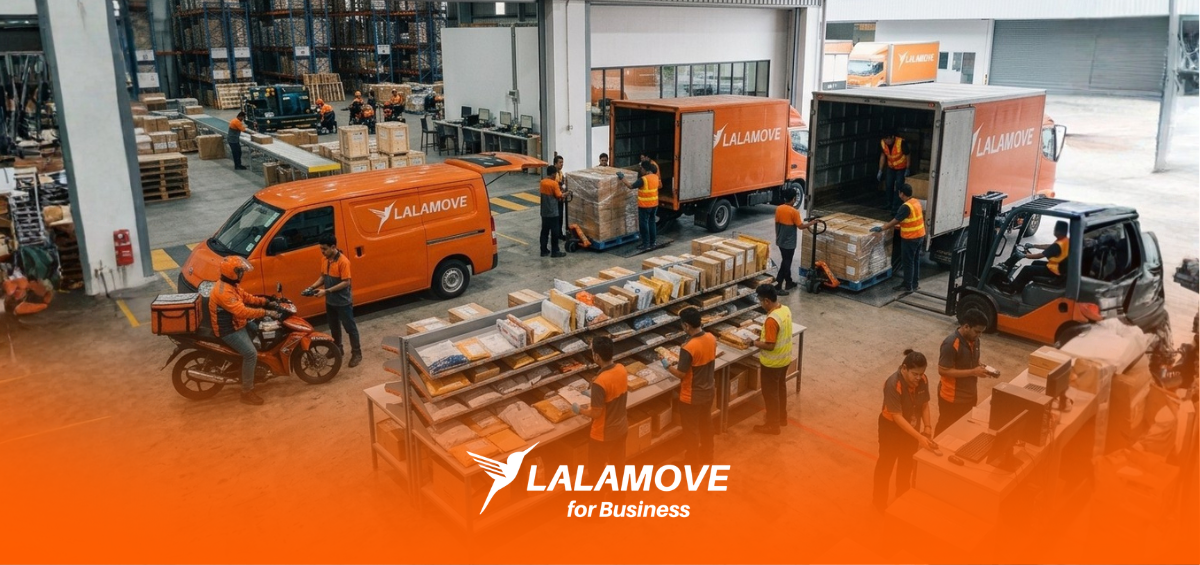
A delivery operation becomes “high volume” when booking, checking status, and reconciling receipts stop being a shared task and become one person’s full-time job. That is the practical threshold. At 20 bookings a day, one staffer can handle delivery alongside other work. At 100 to 200 bookings per day (depending on the business), the same steps fill a logistics assistant’s entire day, and a faster vehicle does nothing to reduce that workload. Dependence on one person also leaves the operation fragile. An unexpected spike in orders, heavy traffic, or a single sick day can stall the operation. Ensuring efficiency at high volume means reducing that dependence, not just moving faster.
This is why volume, not speed, is the core management challenge as logistics operations expand. Efficient delivery management means minimizing the effort spent booking, tracking, and accounting for orders. Unseen on delivery invoices, this work consists of the repetitive minutes spent creating bookings and following up on status. Volume also fluctuates — payday weekends, promo surges — so orders can spike without any rise in staff to process them.
A high-volume delivery solution has to reduce that work, not simply supply more vehicles. This guide explains where the work time goes at volume, what to change first, how to automate booking, and when a different arrangement is the better answer.
What Is a High-Volume Delivery Solution?
A high-volume delivery solution is a delivery setup that handles a large number of bookings without adding staff or increasing work-hours every time orders increase. It rests on three things. Vehicles you can book on demand. One account that every booking runs through. A connection that lets your own systems place bookings without manual encoding.
Volume changes which problem you are solving. At low order counts, the question is whether a vehicle is available. At high counts, the vehicle is rarely the constraint — the coordination around each booking is. A company can have excellent vehicle availability and still run an inefficient operation, because its staff spends their mornings on data entry.
Where the time goes when volume is high
-
Encoding. Every booking keyed in by hand takes a few minutes, and those minutes add up to a full-time role.
-
Vehicle matching. Book a truck for a load a van could take, or split one truckload across three vans, and you pay for the mismatch every day it repeats.
-
Status checks. Someone has to answer every call and message asking where a delivery is, and those queries increase along with the order count.
-
Expense Reconciliation. Orders spread across multiple vendors and individual employee accounts require consolidating data from disparate platforms just to calculate total monthly expenditure.
Only one of those four is about vehicles. That is the whole point of the section that follows your logistc partner.
How Do Businesses Manage High-Volume Deliveries?
Businesses manage high-volume deliveries by cutting the handling time on each booking, fitting the vehicle class to the load, consolidating drops so fewer trips are needed, and running every booking through one account. To tackle operational strain, companies usually address four key areas in order of impact.
1. Cut the handling time on every booking
Start with the step you repeat most. At volume, a booking costs more than its fare: it costs the minutes spent creating it, and the errors that come from entering the same details by hand all morning. Standardize what your team encodes: pickup point, contact, vehicle class, handling instructions. A booking then becomes a short form with a few variables instead of a fresh decision each time. Once order volume exceeds what your staff can encode manually, a faster manual process is no longer the solution. The solution is to remove the manual step entirely, as covered in the automation section below.
2. Fit the vehicle to the load, then combine drops into fewer trips
Two vehicle decisions save the most time at volume. The first is sizing. Book the class that fits the actual load, so you are neither paying for space you do not use nor splitting one load across several separate bookings and drivers. The second is consolidation. Multi-stop routing combines several drops into one trip, so 12 deliveries in the same area become one booking to manage instead of 12. Fewer trips also mean less status monitoring and fewer lines to reconcile.
3. Manage by exception, not by phone call
Decide what actually needs monitoring. With live tracking, a dispatcher managing 200 orders does not have to confirm that the 190 on-track deliveries are moving — only the 10 that are behind. Set your exception triggers ahead of time: a pickup not assigned by its cut-off, or a delivery past its committed time. Deliveries that stay within their expected timelines proceed without manual follow-up. For a high-volume dispatch team, managing by exception instead of checking every order is the biggest change to the daily routine.
4. Keep one record so volume does not overwhelm finance
Run every booking through one corporate account. When 200 deliveries a day are booked across personal accounts and a handful of vendors, nobody can state what the week cost until every receipt is collected. A Lalamove corporate account gives authorized users in operations, finance, and procurement the same bookings, real-time tracking, a centralized wallet, and monthly statements. At volume, that gives you figures you can rely on: cost per delivery, cost per branch, and cost per day.
Consolidating bookings is also one reason a business logistics solution scales without being rebuilt. The reason to consolidate here is narrower: you cannot manage a delivery cost you cannot measure, and at 200 deliveries per day, scattered bookings make that difficult.
How Do You Automate Deliveries at High Volume?
You automate deliveries by connecting your ordering system to your delivery provider, so a confirmed order becomes a booking without anyone encoding it twice. An API is simply a set of rules that lets two systems pass data to each other automatically. Delivery status then posts back into the same record your team already uses.
Lalamove supports API integration for business accounts, so bookings are placed and tracked from inside a company's own ordering system. Businesses selling on Shopify can connect directly and quote delivery cost at checkout. Companies selling across online and offline channels can manage delivery requests in one place. That is what multi-channel fulfillment needs onccae volume is high: one delivery process, not one per channel.
Automate what repeats. Use human oversight for exceptions.
The useful question is not whether to automate but what to leave alone. Automate the parts that repeat without judgment: creating the booking, applying the standard vehicle class for a known order type, posting status back to the order record. Keep people on the parts that need a decision. The delivery that has to be rescheduled because a receiving bay closes at four. The load that is heavier than the order form says. Teams that automate everything can end up handling more exceptions by phone than before, because the system applied the wrong standard rule to hundreds of orders at once.
Which Logistics Company Handles Bulk Deliveries in the Philippines?
Lalamove handles bulk delivery volume for businesses in the Philippines, booked on demand rather than reserved in advance. That account covers motorcycles and sedans, 1,000 kg and 2,000 kg vans, and trucks at 3,000, 5,000, 7,000, and 12,000 kg. It also covers first-mile pickup, inter-facility transfers, and last-mile drops, so a heavy week does not need a separate provider for each delivery type. Lalamove serves designated areas across Luzon and Cebu, and vehicle and route availability varies by location. Confirm that the classes you depend on are serviced where you operate.
But handling the volume is the starting point, not the payoff. The real benefit for a high-volume operation is that one account lets you scale the deliveries without scaling the manual work behind them. The capability stacks in one place: one account books every vehicle class, one dashboard tracks every delivery, one wallet and one statement settle the billing, and multi-stop routing turns many drops into fewer trips. Each layer removes handling work that would otherwise grow with the order count.
Automation is what takes that efficiency further
API integration is where high-volume delivery stops translating into “high stress” or high-volume work. When your ordering system is connected to Lalamove through an API, a confirmed order becomes a booking on its own — no one re-encodes it, no one copies an address, no one keys in a vehicle class. Businesses selling on Shopify can connect directly and quote delivery cost at checkout. The work that used to fill a staffer’s day does not just get faster; it stops being manual work altogether. That is what makes the job simpler and the operation calmer as volume climbs: the system does the repetitive part, and your people are left to handle only the deliveries that actually need a decision.
A composite example shows the range one account absorbs in a single day (illustrative, not a specific customer). A cosmetics and fashion distributor supplying department-store counters and mall concessions runs three kinds of delivery in the same day. Replenishment for 30 counters across two cities goes out as multi-stop trips in 1,000 kg vans. A pallet transfer from the main warehouse to a satellite stockroom takes a truck. A missing tester set that a counter needs before the mall opens goes by motorcycle. All three are booked on the same corporate account, tracked in the same place, and appear on one monthly statement.
The business used three vehicle classes that day for three different urgencies and produced one set of records. That is what enterprise delivery on one account looks like on a busy day. As delivery volume grows, Lalamove's corporate account tiers add higher-touch support and reporting for larger operations.
Good to know: protection comes built in.
Every delivery booked through a Lalamove business account includes automatic insurance of up to ₱75,000 through Pioneer Insurance, subject to policy terms — no one has to remember to add it. For higher-value shipments, Goods Protection Promises is a separate, optional paid program: coverage of up to ₱8 million, priced per booking and subject to assessment and its own terms. The two are distinct: the ₱75,000 applies automatically; the higher tier is bought per booking. It is a useful backstop at volume rather than the reason to consolidate.
Handling Peak Volume Without Building for the Peak
High volume is rarely flat — that is, steady from week to week. The efficient setup is sized for the ordinary week and can add capacity for the busy one. A company that owns enough vehicles for its heaviest week finances, insures, and parks them through the 40 weeks it does not need them. Booking the surge instead keeps that portion of capacity variable — capacity you pay for only in the weeks you use it. That is what fleet elasticity means in practice.
Volume surge management starts as a sorting exercise. Take last month's deliveries and split them into the ones you knew about a day ahead and the ones you did not know about. The first group is what a fixed arrangement handles well. The second has to be available on the day. That share is usually larger than a team expects: payday weekends, promo periods, a client's month-end push. The split between planned and unplanned volume is the subject of same-day and scheduled delivery for business, and it also decides how much fixed capacity is worth owning.
Within a single booking, Lalamove's in-app priority option can speed up driver matching when a delivery cannot wait. Availability still varies by area and vehicle class, so treat it as a better chance of a fast match rather than a guarantee of one.
When a Different Setup Makes Sense
No single arrangement suits every high-volume operation, and an honest evaluation should say where the fit ends. If most of your volume runs on fixed routes at high frequency, an owned or contracted fleet is usually the more efficient way to handle that base. On-demand capacity earns its place on everything the base was never sized for. The cost side of that trade-off is addressed by how to reduce delivery costs without sacrificing speed. If your distribution is genuinely national, note that Lalamove serves designated areas across Luzon and Cebu, with vehicle and route availability varying by location. A national operation will still need more than one partner. And goods requiring temperature-controlled or regulated hazardous transport call for specialized carriers built for those requirements.
Key Takeaways
|
|||||||
If delivery volume in your operation is being managed by people rather than by a process, the fastest test is a full week. Run one busy week through a single corporate account and count the staff hours it saves. Open a corporate account or talk to the Lalamove business team.
FAQs About High-Volume Delivery for Businesses
What counts as high-volume delivery for a business?
High-volume delivery is a delivery operation large enough that booking, tracking, and reconciling become one person’s full-time job. There is no single order count that marks the line. The practical test is staffing. If someone spends most of a working day creating bookings, checking statuses, and matching receipts, the operation is already running at high volume.
How do businesses manage high-volume deliveries?
Businesses manage high-volume deliveries by reducing the work each booking takes. They standardize how bookings are created. They fit the vehicle class to the load. They combine several drops into one trip. They run every booking through one corporate account so status and spending stay visible. Past a certain order count, they let their own system place the bookings.
What is the difference between bulk delivery and batch booking?
Bulk delivery describes the goods being sent, usually a large quantity in one trip or one day. Batch booking describes how the deliveries are created, with several bookings placed in one action instead of one at a time. A business can send bulk deliveries without batch booking. It can also batch-book many small deliveries.
What should a business look for in a high-volume delivery solution?
Look for four things. The vehicle range should cover your smallest and largest load on one account. Capacity should be available on the day, not only when volumes are agreed in advance. The account should let several authorized users book and track from the same records. The platform should connect to the ordering system you already run.
How do I automate deliveries for my business?
You automate deliveries by connecting your ordering system to your delivery provider through an API. An API is a set of rules that lets two systems pass data to each other automatically. Lalamove supports API integration for business accounts, so bookings are placed and tracked inside your own system. Businesses selling on Shopify can connect directly.
Does higher delivery volume lower the cost per delivery?
Higher volume lowers the cost per delivery only when the volume is organized. Combining several drops into one trip spreads one trip's cost across several deliveries. Booking capacity on demand keeps that cost variable, so a slow week costs less. Volume by itself does not reduce cost. Scattered bookings and partially loaded vehicles cost more at 200 deliveries than at 20.
Are business deliveries insured?
Deliveries booked through a Lalamove business account are automatically insured up to ₱75,000 through Pioneer Insurance, subject to policy terms. Higher-value shipments can be covered separately through Goods Protection Promises. This is an optional paid program offering coverage up to ₱8 million, priced per booking and subject to assessment and its own terms. The two are separate. The ₱75,000 insurance applies automatically. The higher coverage is purchased per booking.
When is an owned or contracted fleet better for high volume?
An owned or contracted fleet is the better answer when most of your volume runs on the same routes at the same frequency. A fixed arrangement is built for planned, repeating work, and the cost per trip is lower. On-demand capacity is for the volume that arrives without notice, and for loads the fixed arrangement cannot take.
Can I automate high-volume deliveries with Lalamove?
Yes. Lalamove supports API integration for business accounts in the Philippines, so a confirmed order in your own system becomes a booking without manual encoding. Businesses selling on Shopify can connect directly and quote delivery cost at checkout. One corporate account still covers every vehicle class, from motorcycles to 12,000 kg trucks, across designated areas in Luzon and Cebu, with availability varying by location.
How does a business start booking high-volume deliveries with Lalamove?
A business can open a corporate account through the Lalamove for Business page and add the staff who need booking access. Booking can start without a fixed monthly commitment. Vehicles do not have to be reserved in advance. For teams booking at volume, the next step is usually connecting an ordering system.


