


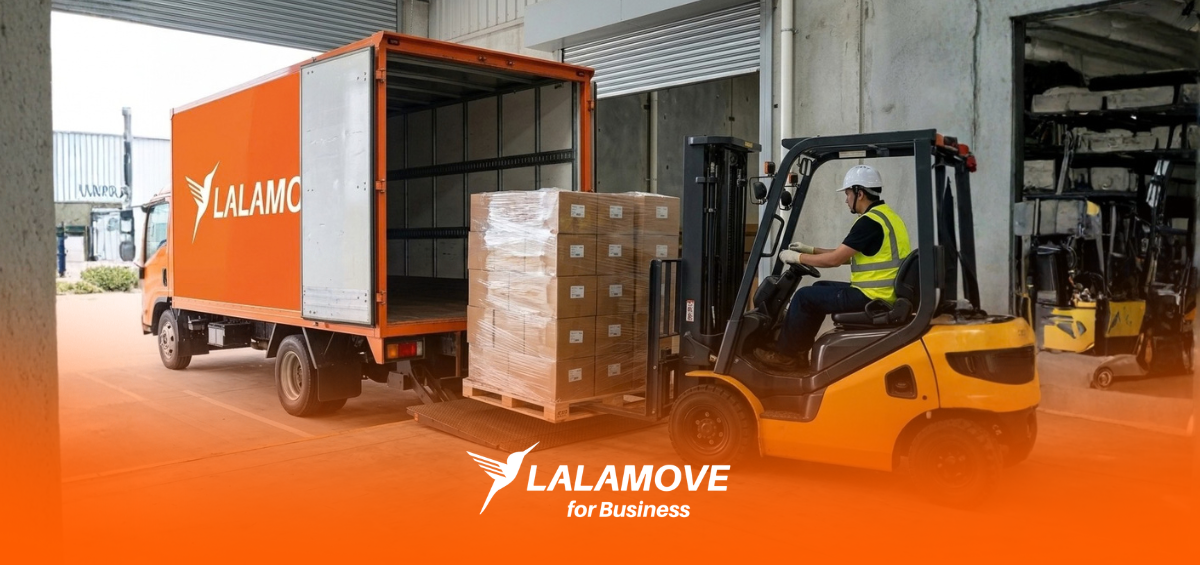
Manufacturing logistics is all the transport that keeps a plant running and its goods moving to market. Positioned as the transport arm of operations, distinct from inventory management or production planning, it manages the movement of materials and finished inventory aligned with production schedules. Primarily, this includes bringing components and raw materials from suppliers or ports into the facility. Additionally, it also covers the outward distribution of finished inventory to warehouses, distribution hubs, commercial partners, and end consumers. This movement determines whether a factory's output meets its market delivery commitments.
What makes manufacturing logistics distinctly challenging is that factory output is generated in discrete batches, while client demand flows continuously. Output arrives in bulk at the end of a run. Demand, however, arrives in pieces all month. Most manufacturers fix this mismatch with one fleet or one contract sized somewhere in between. This means the same vehicles run partly loaded for three weeks and cannot clear the dock on the fourth.
Plant logistics operates across two distinct layers, and optimizing distribution requires managing them accordingly. There is the base layer (weekly routes with predictable volume) and the variable layer (i.e., everything else, such as the surge at the end of a production run, material that must reach the line before the shift starts, and time-sensitive dealer orders). This guide examines both layers, identifies common bottlenecks, and highlights which shipments specialist providers handle best.
What Is Manufacturing Logistics, and What Does It Cover?
Manufacturing logistics comes down to four trips. Raw materials and parts come in from suppliers and ports. Finished stock goes out from the plant to a warehouse or a distribution hub. From there, it moves again to dealers, retailers, and customers. And the empties come back: pallets, crates, and stock a customer rejected. The trade files all of this under a wider name, industrial logistics, which is the same work for any plant or warehouse.
Manufacturing logistics gets used loosely, so it helps to be plain about it. A plant has three jobs to run: decide what to make, store it, and move it. This article is about the third: moving it. Storage and stock control are their own trade, with their own providers, and are not what a delivery arrangement handles. What it does handle is the practical part: which vehicle takes which load, when you book it, and who can see the record afterward.
How Can Manufacturers Improve Distribution?
Manufacturers improve distribution by splitting it into two kinds of delivery and handling each on its own terms. One kind is steady: the same routes, the same volume, every week — you can plan these and put them on a fixed schedule. The other kind is not: the sudden surge, the urgent order, the trip nobody saw coming — you book these on the day. Most plants run both on one fixed fleet, and that is the root of the problem. The fleet ends up too big for a quiet week and too small for a busy one.
The two layers are not competitors. A contracted arrangement is built for the base layer and does that job well once it is sized correctly, and the variable layer is what keeps a correctly sized base layer from failing the moment production behaves unusually.
The base layer: the predictable routes
Some deliveries you can see coming one month ahead. Those are the base layer: the same finished goods leaving the same plant for the same warehouse, on the same days, at a volume the production schedule already tells you. This is factory delivery in its steady state; you can plan warehouse distribution, so put it on a fixed schedule. The same rule applies when choosing between same-day and scheduled deliveries: plan predictable volume, and book only exceptions on the day.
The far end of that chain, the delivery a store receives and puts on a shelf, is treated from the receiving side in a companion guide in this series on logistics solutions for retail businesses. The view here is from the plant.
Using a fixed fleet isn't the error; the mistake is scaling it to accommodate peak-quarter activity. Maintaining a fleet sized for maximum volume creates costly idle overhead for the rest of the month; a companion guide in this series covers the math and how to reduce delivery costs without sacrificing speed. Once you scale the baseline layer around consistent, repeating demand, you can efficiently address surplus volume.
The variable layer: managing production fluctuations
Within a manufacturing plant, the variable layer encompasses all logistics needs outside the baseline distribution schedule, which typically appears in three distinct scenarios:
The first is the end-of-run surge: A plant finishing a large order in the last week of the month can produce in a few days what it normally ships in three weeks. The contracted trucks are not due until Thursday, so finished goods stack up at the dock, and a blocked dock is not just a delivery delay. It also takes floor space which the next production run needs and forces staff to move pallets twice to make room.
The second is the inbound emergency: A component or a raw material that does not reach the line before the shift starts stops the line, and a stopped line is paid labor with nothing coming off it. Logistics people call that inbound leg first-mile transport, from a supplier, a port, or a bonded warehouse to the plant gate. A manufacturer usually experiences it as a phone call at six in the morning. Sector-specific treatments of that leg, and of the mid-mile transfer that follows it, are covered separately in this series in the guides on first-mile and mid-mile distribution for FMCG companies and for food and beverage brands.
The third is the order that does not match the pattern: A dealer that sells out early, a retailer opening a new branch, a trade order for a customer the distribution route does not pass. Each is small next to a full line-haul, and each is the kind of order that gets refused or delayed when the only available capacity is a scheduled truck already assigned.
Address these scenarios with fleet elasticity (on-demand capacity that expands during busy weeks and scales back during lulls). Effective volume surge management, in this context, means booking extra vehicles only when docks are full. A single booking can look expensive next to a freight rate. Set it against idle line hours, a production run that slips, and a customer who orders elsewhere next month, and it is usually the smaller number.
One record for both layers
Distribution management is the part most plants lose when they run their two layers separately. The contracted base layer appears on monthly invoices, while shift staff manages the variable layer out of pocket, keeping it off operations reports. As a result, true exception expenses and their recurrence stay hidden during quarterly evaluations, obscuring whether the base fleet is correctly sized.
Putting both layers on one business account fixes the record. Bookings, tracking, proof of delivery, and billing sit in one place, and the exception volume becomes visible as a pattern.
What Logistics Solution Is Best for Manufacturers?
The logistics solution a manufacturer needs is on-demand capacity it can add to the fixed fleet it already runs, not a second fleet to replace the first. A contracted fleet handles the recurring routes. It cannot stretch to the three things that fall outside them: the production surge at the end of a run, the inbound part a stalled line is waiting on, the order that does not sit on a regular route. An on-demand provider fills that role. A manufacturer already running its own trucks does not replace them; it books the flexible layer for exactly the deliveries the fixed fleet cannot flex to cover.
Lalamove is one example, because its enterprise logistics service puts that range on one business account. That account offers motorcycles and sedans, 1,000 kg and 2,000 kg vans, and trucks with capacities of 3,000, 5,000, 7,000, and 12,000 kg. This gives manufacturers more options when choosing a vehicle. For example, a motorcycle can be used for a small component that needs to reach the plant quickly. A van can handle a dealer top-up, while a larger truck can move finished goods from a plant to a warehouse. (Matching a specific load to the right class is discussed in a companion guide in this series on choosing the right delivery vehicle for different business needs).
The same account covers first-mile to last-mile movements, so a pickup from a supplier and a delivery to a customer sit in the same record.
This can be useful for manufacturers with several sites. Authorized users from production, logistics, finance, and procurement can view bookings, delivery costs, and other account information. They can also track deliveries in real time and receive monthly statements.
A manufacturer selling through distributors, dealers, and its own online channels runs multi-channel fulfillment, and one account keeps plant and warehouse delivery requests together.
For plants that book from their own systems, an API integration bridges systems to automatically exchange booking and real-time tracking data, eliminating manual entry. An API is a set of rules that lets two systems share data without a person retyping it, and API automation keeps a growing operation from adding an encoder for every new site. Businesses selling through Shopify can also connect through a direct plugin.
The pay-per-use model allows manufacturers to add delivery capacity when they need it. Instead of keeping extra vehicles for the busiest weeks of the month, a plant can book additional vehicles when production or orders increase. This gives the company more capacity without maintaining another fleet, which is the supply chain agility a plant needs when its output is known in timing but not in volume. It also makes the arrangement scalable logistics rather than a fixed setup: a new plant or dealer area adds bookings, not a new vendor relationship.
Manufacturers running at higher volumes can move to a higher corporate account tier, which adds more hands-on account support and deeper reporting for teams managing several sites at once.
When a Manufacturing Delivery Belongs Somewhere Else
On-demand delivery has limits. Some manufacturing shipments are better handled by specialist providers or through a fixed logistics arrangement.
Hazardous materials: Industrial chemicals, solvents, compressed gases, flammables, and other dangerous goods may require licensed carriers, special vehicles, documentation, and specific handling procedures. Assign these shipments to a specialist carrier.
Oversized cargo: Transformers, production line equipment, industrial presses, and other large items may require cranes, permits, escorts, or specialized crews. These are project shipments, not regular delivery bookings. The same applies to equipment being delivered to a new plant without a working dock or receiving team.
Warehousing: Transportation only moves goods between locations. It does not store inventory, count stock, pick orders, or hold goods for later delivery. Manufacturers that need inventory stored near a market will need a warehousing provider.
Regular high-volume routes: A dedicated or contracted fleet may cost less per trip when the same vehicles make the same route every day at a predictable volume. On-demand delivery is better suited to additional shipments outside those regular routes.
Coverage has a boundary worth checking early. Lalamove operates in designated areas across Luzon and Cebu, with vehicle and route availability that varies by location, so a manufacturer distributing nationwide will still need more than one partner.
Key Takeaways
|
|||||||
The vehicle decision is easiest to test on the runs that already cause trouble: the bulky load that fills a van early, the multi-stop day, the address with a clearance limit. Open a corporate account or talk to the Lalamove business team
Frequently Asked Questions
What is manufacturing logistics?
Manufacturing logistics is the movement of materials and finished goods around a production schedule. It covers inbound raw materials and components to the plant. It covers transfers from the plant to a warehouse or distribution hub. It covers outbound delivery to dealers and customers, and the return leg for pallets and rejected stock. It does not cover production planning or storage.
How can manufacturers improve distribution?
Manufacturers improve distribution by splitting it into two layers. Size a base layer for the routes that repeat at predictable volume, and carry it on a scheduled or contracted arrangement. Book a variable layer for day-to-day surges and exceptions. Most distribution problems come from running both layers on one fixed fleet.
What is warehouse distribution for a manufacturer?
Warehouse distribution is moving finished goods from a plant to a regional warehouse or distribution hub. It also covers the onward delivery from that hub to dealers, retailers, and customers. For a manufacturer, it is usually the most predictable part of distribution, because the volume is known from the production schedule and the route repeats.
How do manufacturers handle production surges?
Handle a production surge by booking extra capacity for the days the dock is full, rather than owning vehicles sized for the heaviest month. A plant finishing a large order can produce in days what it normally ships in three weeks. On-demand trucks clear the dock so the next run has the floor space it needs.
What vehicles do manufacturers need for factory deliveries?
A plant needs a range rather than one class, because its movements differ in weight. Lalamove offers motorcycles and sedans, 1,000 kg and 2,000 kg vans, and trucks at 3,000, 5,000, 7,000, and 12,000 kg. A motorcycle suits an urgent component. A truck suits a plant-to-warehouse transfer.
Can a logistics provider move raw materials from a port or supplier to a factory?
Yes. That inbound leg is called first-mile transport, and it covers pickups from suppliers, ports, and bonded warehouses to the plant gate. It is booked the same way as any other delivery, with the vehicle chosen based on the material's weight. Regulated and hazardous materials are the exception and need a licensed specialist carrier.
Does Lalamove transport hazardous or oversized industrial cargo?
No. Regulated and hazardous materials, including industrial chemicals, solvents, and compressed gases, need a carrier licensed and equipped for that classification. Oversized project cargo such as a production line module or a transformer needs permits, lifting equipment, and a crew at both ends. Book those with a specialist and use on-demand delivery for general industrial loads.
What should a manufacturer ask a logistics provider?
Ask a provider these questions before opening an account:
-
Which vehicle classes are available near the plant and each warehouse?
-
How quickly can a truck reach the plant when a run finishes early?
-
Can production, logistics, finance, and procurement work from one account?
-
What tracking and proof of delivery do you record for every booking?
-
What protection applies to goods, and what are its terms?
-
Which materials will the provider not carry?
Which logistics provider supports manufacturers in the Philippines?
For manufacturers in the Philippines, Lalamove covers plant, warehouse, and dealer movements on one business account. That account holds inbound material pickups, plant-to-warehouse transfers, and outbound deliveries. Vehicles range from motorcycles to 12,000 kg trucks. Lalamove serves designated areas across Luzon and Cebu, and vehicle and route availability varies by location.
How does a manufacturer start using Lalamove for distribution?
Open a business account through the business page. The account gives authorized users in production, logistics, finance, and procurement shared access to bookings, tracking, and monthly statements. Plants that book from their own systems can connect by API. Start with the exception moves, then review what the base layer should cost.


