


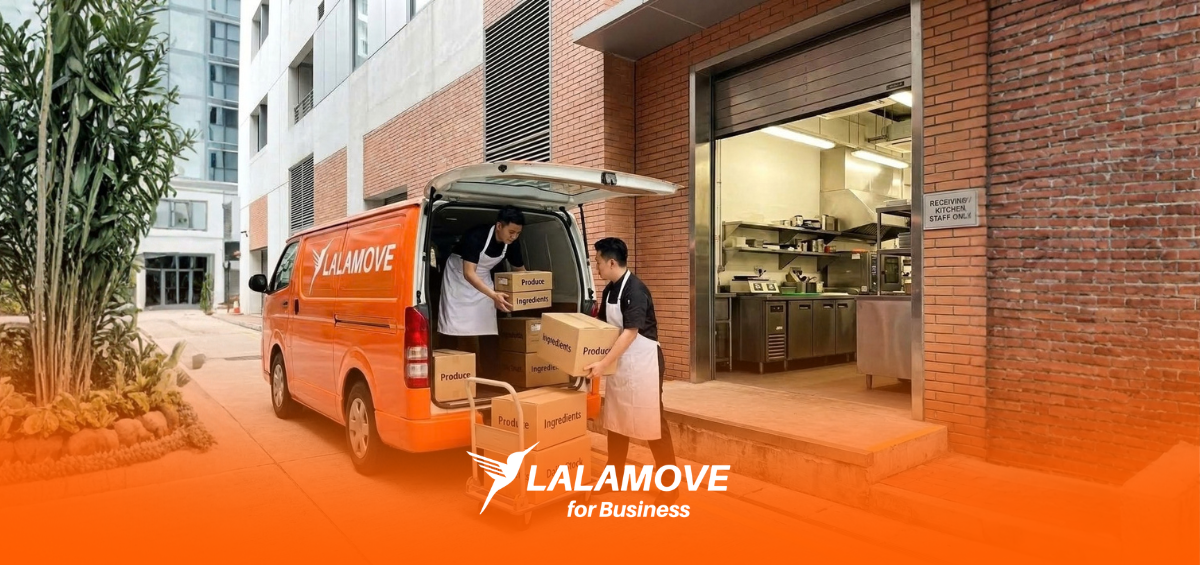
Restaurant delivery solutions are how a food chain keeps every branch supplied: getting ingredients, packaging, and equipment to each branch and between branches, on one account, against a service window that opens at the same time every day and cannot be moved. Focused entirely on supply-side operations, restaurant delivery solutions manage incoming inventory rather than customer-facing meal fulfillment.
That strict service window is unique to restaurants and largely defines how logistics operations are managed. A retail store that runs short of an item loses that item's sales until the next restock, and it can usually wait. A restaurant that runs short of one component during service can lose most of the dishes that use it for the rest of the night, and that component is often the smallest thing on the invoice — a sauce, a portion of rice, a container. Since the stakes are high and the timing is non-negotiable, a restaurant chain cannot rely on a single, static delivery setup for its supply needs.
In practice, a chain runs three deliveries, and each serves a different operational window. There is the commissary run that stocks each branch before service; the borrow between branches when one runs short during service; and the catering and returns that move outside service hours. Most chains plan the first well and improvise the other two. This article walks through all three the way an operations manager would think about them, shows where a service night breaks down, and marks the loads a food chain should route to a different kind of logistics provider.
What Are Restaurant Delivery Solutions, and Why Do Food Chains Need Them?
Restaurant delivery solutions are the arrangements a food chain uses every day to keep every branch supplied across three key periods: before service, during service, and outside service. In logistics terms, this is called food distribution, but on the ground it is simpler to picture as three separate deliveries, each measured against a service window that opens at the same time every day and will not wait.
Most chains build the first delivery well and improvise the other two. Each branch plans, routes, and repeats the morning stock run in advance because its daily volume is predictable. When unexpected inventory shortages hit mid-service or weekend catering orders arrive, handling them often falls on whichever staff member happens to be available. That imbalance often breaks a service night because restaurant logistics does not stop when the doors open. It keeps going through service, in response to what customers actually order. Naming the three deliveries is the first step to running each one on purpose rather than by reflex.
Before service: the commissary run
The commissary run is the delivery that stocks each branch before it opens. A central commissary, or a main branch that preps for the others, sends out bulk ingredients, prepped items, packaging, and disposables so every branch starts the day with what its menu needs. This is the one restaurant delivery you can plan properly, and it is worth planning well. You know the volume from yesterday's sales and today's forecast, the route repeats, and you can fill the vehicle before it leaves.
Logistics people call this branch replenishment, and it differs from a retailer's version in one key way. Both are planned ahead from known numbers. What differs is the deadline. A store's replenishment is pegged to a sales forecast; a restaurant branch's is pegged to a service window, which means the stock has to be inside the branch and checked in before the first order, not merely sometime that day. A commissary run that arrives an hour into lunch service has effectively failed, even if every case on it is correct. Getting food business logistics right starts here: time the delivery to the window, not to the calendar.
During service: the mid-service shortage
A mid-service shortage is a component running out after service has started, when the next commissary run is not until the following morning. It is the delivery you cannot schedule or skip, and it's what sets food apart from most other kinds of retail.
Picture two branches a few kilometers apart. One runs out of its house sauce at seven in the evening, and that sauce sits at the center of a dozen menu items. The other branch has three cases of it in the back. Wait for tomorrow's commissary run, and most of those dishes come off the menu for the rest of the night. Book one vehicle to go straight from the second branch to the first, and the sauce is back on the line within the hour. Logistics calls this move a lateral transfer between branches; a chef just calls it a borrow.
This is where the real cost sits, and it is easy to misread. The item that ran short is often the least expensive thing in the kitchen: a sauce, a portion of rice, the container the best-selling order goes out in. Set the vehicle against the price of that item and the booking looks hard to justify. Set it against a full menu section going dark on a busy night, and against the diners who leave when their order cannot be filled, and the picture changes. A mid-service delivery is weighed against lost covers and a table that may not come back, not against the ingredient cost. This lateral move is the fastest correction a chain has, and it is a different job from the retail transfer that repositions slow stock over days; here it is a short borrow during live service. (The retail side of that story is covered in a companion guide in this series on logistics solutions for retail businesses.)
Outside service: catering and returns
The third delivery runs entirely outside the service window, and it moves in two directions. Catering and bulk orders go out: a corporate lunch for 200, a party-tray order, an off-site event the chain is feeding. These are heavy, tied to a specific time, and usually too large for the small vehicles a branch might otherwise improvise with. They call for a closed van or a truck sized to the order, booked for a set arrival time.
The other direction runs backward. Reusable crates, unsold prepped stock moving between branches, and packaging returning to the commissary all have to travel back up the line. None of it is urgent on the night, which is exactly why it tends to pile up in a branch's limited storage. The simplest fix is to book the return on a vehicle already going that way, so a commissary run that drops stock in the morning brings the crates back on the same trip.
How Do Restaurants Manage Deliveries Across Branches?
Restaurants manage multi-branch deliveries by separating the run they can schedule from the ones they cannot, then booking both through one account so head office can see what every branch is moving and spending. The commissary run is sized from known volume and booked in advance. The mid-service shortage and the urgent catering order are booked on the day they come up. Do those two things well, and the rest is mostly discipline.
Schedule the commissary run; book what service demands
Sort the delivery week into two lists. The first holds what repeats at a known volume: the morning commissary run to each branch, the weekly return of crates and packaging, the occasional equipment move. Schedule those, and size any fixed arrangement around them.
The second list captures every unpredictable operational demand that arises once service begins:
-
A component that sells faster than the forecast anticipated
-
A borrow from the branch across town
-
A supplier pickup that has to reach a branch before the weekend rush
-
A catering order confirmed on short notice
That list cannot be forecast, only answered, and it is the list that usually decides whether a branch can serve its full menu tonight. (A companion guide in this series weighs when to commit to a scheduled run and when to book on the day: same-day versus scheduled deliveries.)
Let branches book, and let head office see it
A branch manager knows the branch's own stock position before the head office does. When a branch faces a stock shortage, the local manager is the first to know. Routing every request through head office delays the fix by an hour when every minute counts. Conversely, letting individual branches handle bookings independently with separate vendors and receipts leads to unmonitored expenditure—an issue thin profit margins cannot easily accommodate.
A balanced approach involves using a single corporate account with designated branch access. This enables shared visibility across operations, finance, and procurement while keeping spending in check.
Beyond regulating expenditure, this consolidated tracking surfaces operational insights—such as identifying branches that repeatedly request emergency top-ups outside scheduled commissary drops. For instance, a branch that regularly sources the same sauce mid-week probably needs a base allocation adjustment.
Size for the ordinary night, and book the surge
A restaurant chain's demand runs on a daily curve, not a season. Every branch has a lunch peak and a dinner peak, and payday weekends and local events lift them further. What a chain usually cannot predict is which branch will sell through which component on which night. Buying more fixed capacity is a poor answer to that, because a vehicle you own and park sits in one place, and the shortage tends to show up somewhere else.
The alternative is what logistics people call fleet elasticity: capacity that stretches to the night's demand and shrinks back after it. In restaurant terms, volume surge management means being able to point a vehicle at the branch that runs short during service, then letting it go when service ends. Booking capacity only when you need it does that. A vehicle the chain owns and parks does not.
Which Delivery Service Supports a Restaurant Chain's Supply?
The ideal delivery service a food chain needs for its own supply covers all three deliveries on a single account, responds on short notice, and offers enough vehicle range to handle both a full commissary run and a one-carton borrow between branches. Many chains already have the first delivery handled by their own vehicle or a contracted route, and that is ideal; where an on-demand service earns its place is the two deliveries you cannot schedule and would not buy a truck for: the mid-service borrow between branches and the catering order too large for a branch to arrange on its own. A chain rarely needs just one kind of delivery; it needs several, and running them through separate vendors is where visibility and control tend to get lost.
One account across the fleet range
Lalamove is a useful example here, because its enterprise logistics service puts that range on one account. A business account provides on-demand access to motorcycles and sedans, 1,000 kg and 2,000 kg vans, and trucks at 3,000, 5,000, 7,000, and 12,000 kg, covering first-mile pickup from a supplier or commissary through delivery to a branch or event address. This setup manages end-to-end movement of goods, not storage: stock counts and warehousing remain under the chain's management and its central commissary. With a single account, a chain can place both a routine, scheduled commissary delivery across all branches and an urgent, single-carton transfer during live service on the same monthly statement. Which vehicle suits which run is its own decision, covered in a companion guide in this series on choosing the right delivery vehicle. Vehicle and route availability varies by location, so confirm that the classes your branches depend on are serviced in your operating areas.
What one account keeps on the record
Multi-stop routing consolidates several drops into one trip, which is what makes a commissary run practical: one van, several branches, one booking. Authorized users across operations, finance, and purchasing work from shared bookings, real-time tracking, a centralized wallet, and monthly statements, so branch delivery activity stays visible without a separate spreadsheet on the side. When a restaurant manager is racing against the clock during a mid-service shortage, tracking the delivery vehicle's location real-time is just as critical as securing the booking itself.
For chains handling orders through proprietary channels, an API integration bridges systems to exchange booking and real-time tracking data automatically, eliminating manual entry. Businesses on Shopify can connect directly. This is what a pay-per-use model looks like in practice: the chain books capacity for the night it needs, rather than holding a fleet sized for the busiest night of the month.
The same insurance covers the run you planned and the one you did not
Protection does not change based on the time of day you book, because it attaches to the business account rather than the type of booking. The scheduled commissary run and the vehicle sent out at seven in the evening fall under one scheme. This matters most for deliveries that carry real value: a bulk catering order for a corporate event, or a piece of kitchen equipment moving between branches, where a loss in transit would fall on the business rather than the driver. Deliveries booked through a Lalamove business account are automatically insured up to ₱75,000 through Pioneer Insurance, subject to policy terms. Higher-value shipments can be covered separately through Goods Protection Promises, an optional paid program offering coverage up to ₱8 million, priced per booking and subject to assessment and its own terms. The two are separate: the ₱75,000 insurance applies automatically, while the higher coverage is purchased per booking.
When a Restaurant Delivery Belongs Somewhere Else
No single delivery service fits every restaurant load. Knowing which loads belong elsewhere is part of running a food chain well.
Chilled and frozen stock is the clearest case, and for a food business it is often the largest. Fresh meat and seafood, dairy, ice cream, and frozen prepped items need a vehicle built to hold a temperature and a provider that runs a cold chain as a service. A closed van keeps rain and dust off packaged goods and holds a set arrival time. It does not control temperature, and insulation alone will not close the gap on a long trip in Philippine heat. A chain moving ambient dry goods and one moving frozen stock are really running two operations, and the second one needs a specialist. Book the dry goods, packaging, and equipment on demand, and keep the cold chain with a provider built for it.
Fixed, high-frequency distribution is the second case. Where the same vehicles leave the same commissary for the same branches every day at the same volume, a dedicated or contracted fleet can cost less per trip. On-demand capacity proves its value when handling unexpected shortages that a fixed route was never designed to accommodate, rather than replacing the routine baseline operations it already manages effectively.
Two further limits are worth stating plainly. Lalamove serves designated areas across Luzon and Cebu, and vehicle and route availability varies by location, so a chain with branches across the whole country will still need more than one delivery partner. And a new branch build-out is not really a delivery job. Transporting kitchen equipment, fixtures, and fit-out materials to a construction site typically requires unloading gear alongside an on-site crew, both of which fall outside the scope of an on-demand booking.
Key Takeaways
|
|||||||
The easiest place to test a setup like this is the delivery you currently improvise: the mid-service borrow between branches, or the catering order too big for a branch to arrange on its own. Put a week of those through one account and count how many reached the branch on time. To open a corporate account or talk it through with someone, visit the Lalamove business team.
FAQs About Restaurant Delivery Solutions
What are restaurant delivery solutions?
Restaurant delivery solutions are the arrangements a food chain uses to keep every branch supplied across three moments of the day. Stock comes in before service on the commissary run. It moves between branches during service when one runs short. It goes out as catering, or back as returns, outside service. A solution is judged on whether it covers all three at the right speed.
How do restaurants manage deliveries across branches?
Restaurants separate the run they can schedule from the ones they cannot. The commissary run that stocks each branch before service is sized from known volume and booked in advance. Mid-service shortages, transfers between branches, and urgent catering orders are booked as they arise. Running both through one corporate account keeps every branch's delivery activity visible to head office.
What is the best logistics company for restaurant chains in the Philippines?
The best fit for a restaurant chain is a provider that handles all three delivery moments on one account, with short-notice availability. It needs a vehicle range that covers a full commissary run and a single-carton borrow between branches. Lalamove offers this through a business account across designated areas in Luzon and Cebu, with availability varying by location.
How do restaurants handle a shortage during service?
Restaurants correct a mid-service shortage by booking a vehicle on demand instead of waiting for the next scheduled commissary run. They source the missing component from the nearest location that has it, often another branch. One vehicle booked for a direct branch-to-branch trip usually restocks the line within the hour, before the affected dishes leave the menu.
What is the difference between a commissary run and a mid-service delivery?
A commissary run stocks each branch from a central kitchen before service, on a planned schedule sized from known volume. A mid-service delivery corrects a shortage after service has started, when the next commissary run is the following morning. The commissary run covers the plan. The mid-service delivery covers what the plan could not predict.
Can one account cover commissary runs, branch transfers, and catering?
Yes. A Lalamove business account covers first-mile pickup from a supplier or commissary, transfers between branches, catering to an event address, and returns. The same account and monthly statement cover a scheduled commissary run and a one-carton mid-service borrow. Vehicle and route availability vary by location.
Are restaurant deliveries insured?
Deliveries booked through a Lalamove business account are automatically insured up to ₱75,000 through Pioneer Insurance, subject to policy terms. Higher-value shipments can be covered separately through Goods Protection Promises, an optional paid program offering coverage up to ₱8 million. It is priced per booking and subject to assessment and its own terms. The two are separate: the ₱75,000 insurance applies automatically, while the higher coverage is purchased per booking.
Which restaurant deliveries should not be booked on demand?
Three kinds of load are better placed elsewhere:
-
Chilled and frozen stock, such as fresh meat, dairy, and frozen prepped items, which needs a provider that runs a cold chain
-
Fixed daily commissary routes at steady volume, where a contracted fleet can cost less per trip
-
New branch build-outs, where kitchen equipment and fit-out material need unloading equipment and a crew on arrival
Does Lalamove support restaurant and food chains in the Philippines?
Yes. Lalamove provides business accounts to restaurant and food chains in the Philippines, covering commissary runs, transfers between branches, catering deliveries, and returns. One account includes motorcycles and sedans; 1,000 kg and 2,000 kg and trucks at 3,000, 5,000, 7,000, and 12,000 kg. Service covers designated areas across Luzon and Cebu, with availability varying by location.
How does a restaurant chain start booking branch deliveries with Lalamove?
A restaurant chain can open a corporate account on the Lalamove business page and add the branch and head office staff who need booking access. Each booking sets the vehicle class, pickup point, and drop-off point. Chains with higher order volume can place bookings through an API integration from their own system.


