


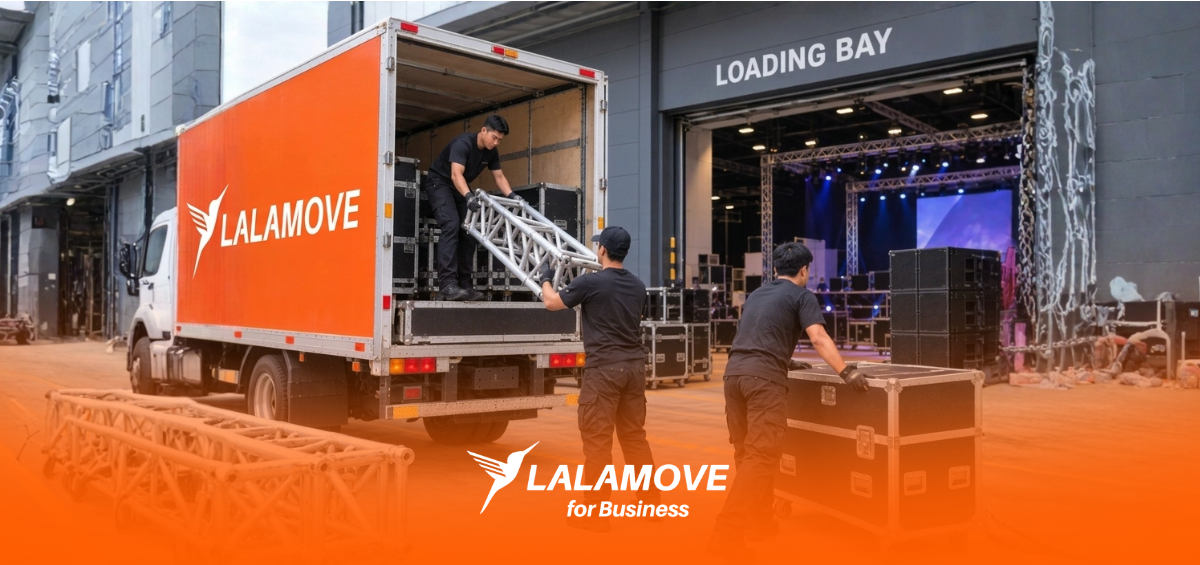
Event logistics solutions move an event's equipment and supplies into the venue during the setup hours the venue allows, then move everything out again before the venue's deadline. Event organizers call these two periods “ingress” and “egress.” At a product launch, ingress can mean three vehicles at one loading bay within the same few hours: a truck with stage platforms and lighting trusses, a van with sound equipment and screens, and a sedan with printed signs. Trusses are the metal frames that hold stage lights. Each crew needs its items before it can start, so the lighting crew cannot hang a single light until the truck arrives.
Two things make this harder than a regular delivery. The fact that venue owners set the ingress and egress times, and that each event happens only once (which means you need to do it right the first time). A late truck cannot come back tomorrow instead, because the doors open on schedule whether the stage is ready or not. Organizers handle this in two parts. They book large setup trips ahead for fixed times and keep on-demand vehicles ready for items added late, such as extra merchandise or a missing cable.
How Do Event Companies Transport Equipment and Supplies at Scale?
Event companies transport equipment and supplies at scale by planning every trip around three periods: setup before the doors open, the show days, and teardown after the event closes. Each period calls for a different kind of trip.
Large-scale event transport has two sides: people and goods. Shuttles for guests and staff are a passenger service. The goods side, from booth walls to boxes of printed programs, is a delivery job, and of course, it needs trucks and vans, not buses.
Ingress: book setup trips in the order the crews need them
Event equipment delivery for ingress works best when trips arrive in the order the crews will use the items. A typical ingress has four or five pickup points across a city: for example, the print shop with the signs, the rental company with the sound and video equipment, the fabricator (the contractor that builds booths and sets) with the booth walls, and your own warehouse with the merchandise. Each is a separate trip, and each ends at the same loading bay.
During ingress, structures go in first, because every other crew builds on them. Stage platforms, trusses, and booth walls arrive in the first hours. After that comes sound and lighting equipment. Signs, decor, and merchandise come last. If a decor truck arrives before the stage is built, it has to wait. That means it would block the bay for the trucks behind it. To avoid this, assign each supplier a fixed arrival time in this order, and book each vehicle for that time.
Check the venue's rules before booking. Many venues give each vehicle a time slot at the loading bay and limit how long it may stay. Large trucks may also face local truck-ban hours on the roads to the venue – take that into account. If a truck misses its slot, it may have to wait behind the others, so set each booking's pickup time to meet both limits.
Show days: small, urgent trips to one address
During an event, most trips tend to be small, urgent, and going to one address: the venue. Examples include a cable failing before a keynote. A sponsor's giveaways unexpectedly run out by noon. A speaker needs a printed document before going on stage. Each item is too small for a truck and too urgent to wait for a scheduled trip. If no vehicle is ready, a staff member leaves the venue to pick it up. This means the event team is one person short during its busiest hours. For things like this, it's best to book a motorcycle or sedan on demand instead, and name one person on site to place these bookings so the same trip isn't booked twice.
Show-day trips make up an event's unplanned share of deliveries. A guide on same-day vs scheduled deliveries for business explains how to measure that share and plan the rest.
Egress: one pickup point, several return addresses
In event logistics, egress is the teardown period after an event, when everything leaves the venue for several addresses before the venue's deadline. Rented sound equipment goes back to the rental company. Booth walls return to the fabricator or into storage, and leftover merchandise returns to your warehouse. Teardown often runs late at night, after the last guests leave. If the venue is not clear by the deadline, it can charge for extra hours or keep part of the deposit. Book the egress vehicles before the event opens, at the same time as the ingress trips.
Because egress starts at one venue, multi-stop routing would be optimal, as it allows for several drops on a single trip. For instance, one van can leave the venue with rented speakers for the rental company and leftover merchandise for your warehouse, and stop at each address in turn. This means fewer vehicles need to wait at the bay while the crew packs, and the venue clears faster.
What Is the Best Logistics Solution for Event Organizers?
The best logistics solution for event organizers can send the right-size vehicle for a fixed time slot, add vehicles on short notice, and keep every trip for an event in one record. Most event organizers may already have provisions for this, in part at least. Rental companies and fabricators often deliver with their own trucks, and they may hire a trucking company for the largest setup items. The gap is every trip those arrangements leave open: the supplier with no truck, the item added two days before the show, the return trips after a late close, and the weekend when three events need trucks at once. When these trips have no booked vehicle, someone has to find one on the day, and setup waits until it arrives.
Lalamove's enterprise logistics service fills that gap as on-demand capacity beside the suppliers' own trucks and any hauler you hire. Every event builds a short, temporary supply chain: the suppliers, the venue, and the trips between them, put together for one event and taken apart after it. Lalamove covers transport in that event supply chain, from first mile to last mile, from each supplier's door to the loading bay and back. It covers end-to-end movement of goods. It does not store equipment between events.
From signs to stage trusses on one account
One Lalamove business account gives access to motorcycles and sedans, 1,000 kg and 2,000 kg vans, and trucks at 3,000, 5,000, 7,000, and 12,000 kg. Motorcycles and sedans would be best for carrying signs, lanyards, and small spare parts. Vans would suit sound systems, lights, and boxed merchandise. Trucks suit the heavy items, such as stage platforms, booth walls, and flooring. A three-day trade expo can use every class in the same week, on the same account and the same monthly statement. Vehicle and route availability varies by location, so confirm that the classes you need are available near both your suppliers and the venue. A guide on choosing the right delivery vehicle for different business needs explains how to match each trip to a vehicle class.
Priority for the trip that cannot wait
An urgent show-day trip cannot start until a driver accepts it, so driver-matching time is part of the delivery time. Lalamove's in-app Priority option matches the booking with a driver faster. Use it for trips where minutes matter, such as a replacement microphone before a keynote, and book the rest as regular trips. Real-time tracking then shows where the vehicle is, so the floor manager knows when to send someone to the loading bay to receive it. (A companion guide in this series covers how real-time tracking improves business deliveries).
Extra trucks for the busy season, paid per trip
Many events tend to fall in the same few months. An events company with its own trucks pays for them year-round, yet in December (when several events line up) it still doesn't have enough. Under Lalamove's pay-per-use model, each trip is booked and paid for separately, so a month without events incurs no vehicle expenses. A guide on how to reduce delivery costs without sacrificing speed sets out the cost side of owning vehicles versus booking them per trip.
In December, a company party, a product launch, and a year-end trade show can fall on the same weekend – each with its own ingress and egress windows. Logistics teams have a name for adding vehicles on peak days and releasing them afterward: “fleet elasticity”. In events management, this is usually called volume surge management: several trucks on the busiest Saturday, and none in the slow weeks after.
Late changes work the same way. When a client adds a stage extension three days before the show, supply chain agility means booking one more truck on the same account for that ingress window. The same logic applies to scaling operations for event organizers. If an organizer goes from four events per month to ten, it makes more bookings, but the account, the billing, and the team that manages the bookings remain the same. That is scalable logistics: capacity grows without more owned vehicles or booking staff.
Every event on one record
No matter how many events a business needs to manage, having a Lalamove corporate account keeps every event's trips in one record. This holds true even when several teams book them. Without it, trips could end up being paid from personal wallets and petty cash, and the finance department cannot see an event's transport costs until all the receipts come in. On the account, the production team, the venue coordinator, and the person handling merchandise each book as authorized users. Finance sees every trip, the centralized wallet, and the monthly statement in one place, so they can review each event's transport as soon as it closes.
A brand that sells merchandise at an event and online often supplies both from one warehouse. That is multi-channel fulfillment, and both the booth restock and the online orders can be booked through the same corporate account.
Insurance when the equipment is rented
Much of an event's most valuable equipment is rented. Rental companies usually own the sound systems, LED video walls, and stage lights, and rental agreements often make the organizer responsible for them until they are returned. One van of rented screens can be worth far more than ₱75,000.
Deliveries booked through a Lalamove business account are automatically insured up to ₱75,000 through Pioneer Insurance, subject to policy terms. Higher-value shipments can be covered separately through Goods Protection Promises, an optional paid program offering coverage up to ₱8 million, priced per booking and subject to assessment and its own terms. The two are separate: the ₱75,000 insurance applies automatically, while the higher coverage is purchased per booking.
Ask each rental company for the replacement value of its equipment before ingress. For any trip whose contents total more than ₱75,000, decide at booking whether to add Goods Protection Promises. Apply the same check to the return trip, because the equipment is just as exposed during egress, often late at night, as it was on the way in. Any claim is assessed under the cover applied to that booking and its terms.
What Should Event Organizers Book With a Specialist?
Four kinds of event work belong with a specialist rather than an on-demand delivery provider. These are food that must stay cold, hazardous materials, on-site crews, and a fixed weekly route.
-
Food and drinks that must stay cold. Lalamove's vans and trucks are not refrigerated. Catering packed to hold its temperature can travel, but keeping it cool is the shipper's responsibility under Lalamove's terms. Book a cold-chain provider for anything that needs refrigeration for the whole trip.
-
Fireworks, fuel, and gas. Pyrotechnics, generator fuel, and LPG tanks for food stalls are regulated hazardous goods. Book them with a licensed carrier, separately from the setup trips.
-
Crews, rigging, and installation. A booking brings the goods to the loading bay. Your production team or the venue arranges unloading crews, riggers who hang trusses, and forklifts at the venue. Pack fragile equipment such as screens in road cases, the hard-shell cases used for stage equipment, before the vehicle arrives.
-
A fixed route every week. If a production company sends the same truck to the same venue every week, such as for a long-running show, a contracted hauler may be a better fit. Book on demand for the trips around it.
Also check the venue's location. Lalamove serves designated areas across Luzon and Cebu. Take note that vehicle and route availability also varies by location. Events outside those areas need a transport partner that serves their region.
Key Takeaways
|
|||||||
Before your next event, write down every trip it needs, sorted into ingress, show days, and egress, and mark which ones already have a vehicle. The trips without one are where an on-demand account helps first. To open a corporate account for your events team, contact Lalamove through its business page.
FAQs About Event Logistics Solutions
What are event logistics solutions?
Event logistics solutions are the transport arrangements that bring an event's equipment and supplies to the venue and take them away afterward. They work within two windows set by the venue: ingress, the setup hours before the event opens, and egress, the teardown hours after it closes. They cover goods such as stage structures, sound equipment, signs, and merchandise, not guest shuttles.
What is the best logistics solution for event organizers?
The best logistics solution for event organizers covers every vehicle size, books trips for fixed setup times, and adds vehicles on short notice. Most organizers combine suppliers' own trucks with an on-demand provider for everything else. Lalamove offers that on-demand layer through one business account, from motorcycles to 12,000 kg trucks, in designated areas across Luzon and Cebu.
How do event companies transport equipment and supplies at scale?
Event companies plan their trips around three periods. During ingress, large items arrive from several suppliers at one loading bay, in the order the crews need them. During the show, small urgent trips bring missing items to the venue. During egress, everything leaves the venue for several return addresses before the venue's deadline. Each period needs a different mix of vehicles.
What are ingress and egress in event logistics?
Ingress is the period a venue allows to bring equipment in and set up before an event. Egress is the period for taking everything down and removing it after the event. The venue sets both, and each happens once per event. If a vehicle misses its ingress slot, every crew that needs what it brings can be delayed.
What vehicles can transport event equipment and staging?
Event equipment needs a range of vehicle sizes, because one event can include printed signs and full stage structures. Lalamove offers motorcycles and sedans, 1,000 kg and 2,000 kg vans, and trucks at 3,000, 5,000, 7,000, and 12,000 kg. Sedans suit signs and small parts. Vans suit sound and lighting equipment. Trucks suit stage platforms and booth walls. Availability varies by location.
What should an organizer do when an item is missing on event day?
Book a motorcycle or sedan on demand for the missing item, instead of sending a staff member away from the venue. For trips where minutes matter, Lalamove's in-app Priority option matches drivers faster. Name one person on site to place these bookings, so the same trip is not booked twice. Real-time tracking shows where the vehicle is on its way to the loading bay.
Can Lalamove deliver food and drinks for an event?
Yes, as long as the caterer or organizer packs the food to stay at a safe temperature. Lalamove does not operate refrigerated vehicles, and its vans and trucks do not control temperature. Under Lalamove's terms, the shipper is responsible for keeping goods cool in transit. Use a cold-chain provider for food or drinks that need refrigeration for the whole trip.
Is event equipment insured during delivery?
Deliveries booked through a Lalamove business account are automatically insured up to ₱75,000 through Pioneer Insurance, subject to policy terms. Higher-value shipments can be covered separately through Goods Protection Promises, an optional paid program offering coverage up to ₱8 million. It is priced per booking and subject to assessment and its own terms. The two are separate: the ₱75,000 insurance applies automatically, while the higher coverage is purchased per booking.
Does Lalamove support event logistics in the Philippines?
Yes. Event organizers, production companies, and corporate teams running company events can book ingress, show-day, and egress trips on one Lalamove business account. Service covers designated areas across Luzon and Cebu, and vehicle and route availability varies by location. To start, open a corporate account through the Lalamove business page and add the team members who need booking access.


