


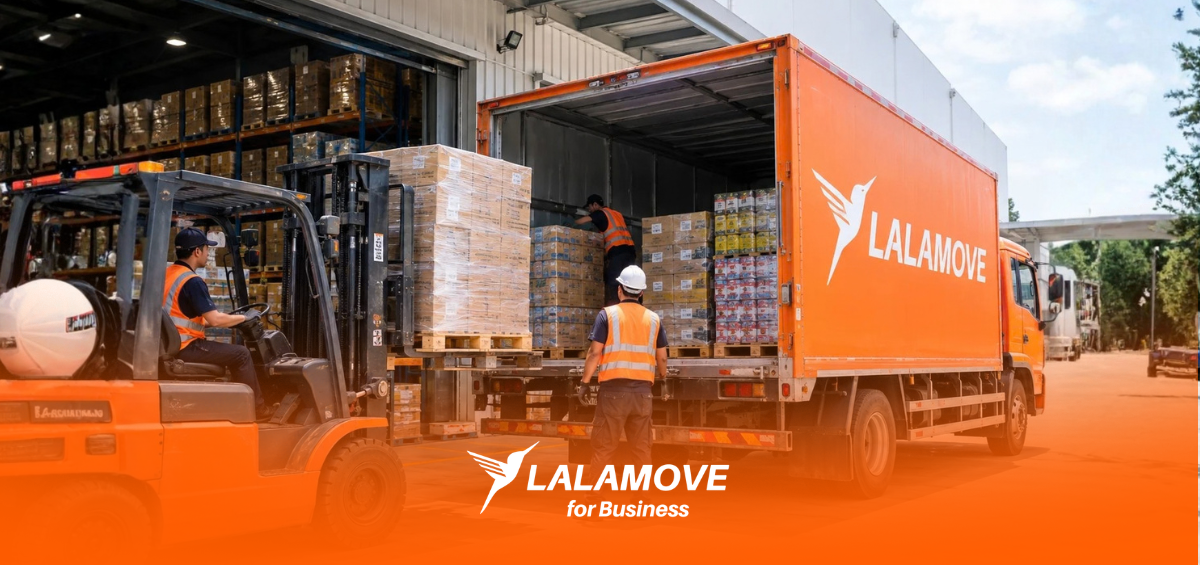
A fast-moving consumer goods brand does not ship the same amount every week. For most of the year, the volume is fairly steady, but a few times a year it rises sharply — during payday weekends, the holiday season, or a major sales promotion — and then it returns to normal. This uneven pattern is what makes high-volume FMCG deliveries difficult to plan. If a company keeps a large fleet ready for the busiest weeks, those trucks stay idle the rest of the year. If it keeps a smaller fleet, it cannot handle the surge when it arrives. The practical answer is to match each shipment to a suitable truck and to add extra trucks only during the weeks when demand rises.
That job has two parts. The first is the truck: which one moves the load, and how much it carries. The second is capacity: where the extra trucks come from during a surge, and where they go after. This article covers both. It also covers how to control a large fleet from one place, and when a bulk shipment is better sent elsewhere. It is about the size of the move, not the map of it. How trucks travel from a central warehouse down to regional hubs is a separate topic, covered in the companion guide on first-mile and mid-mile distribution for FMCG companies.
How Do FMCG Companies Handle Bulk Deliveries?
FMCG companies handle bulk deliveries by making two decisions and solving each separately. The first decision is fitting the load to the truck, so a full pallet run goes in one vehicle instead of three part-loads. The second is fleet elasticity, or the ability to add heavy trucks for a surge and release them after. Get only the first right, and you still stall when volume jumps. Get only the second right, and you still overpay, because your trucks are the wrong size. The strongest FMCG bulk delivery solutions do both from one account. That is what lets bulk goods delivery stop depending on trucks you own year-round.
This is harder for FMCG companies than for most other businesses because of how consumer goods sell. Demand comes in waves, and only some of them are predictable. Steady weekly deliveries to supermarkets and sari-sari networks, plus paydays, the ber-months, and a company's own promotions, add up. A parts manufacturer ships to a fixed schedule and stays there. An FMCG company ships to a schedule too, but several times a year, it needs to ship two or three times as much for a short period. The fleet that fits the regular schedule cannot cope during that period, and that period is when most of the sales happen.
Matching the load to the truck
Get the truck size wrong in either direction and it costs you. Overload it, and the run is unsafe and illegal. Underload it, and you are paying to move air. With only one size on hand, a team does both, splitting heavy loads and sending big trucks out half-empty.
Large vehicle logistics for FMCG works best when you can choose from a full range of sizes. Especially with one account that gives you access to motorcycles and sedans, 1,000 kg and 2,000 kg vans, and trucks at 3,000, 5,000, 7,000, and 12,000 kg. Access to a broad range of vehicle sizes optimizes large-vehicle logistics for FMCG. Through a single account, dispatchers can choose from motorcycles and sedans, 1,000 kg and 2,000 kg vans, and 3,000 kg, 5,000 kg, 7,000 kg, and 12,000 kg trucks. This variety lets logistics teams choose the right vehicle for a load. For example, a 12,000 kg (approximately twelve-ton) truck handles a complete palletized warehouse transfer in a single run, a 2,000 kg van easily manages mid-week store restocking, and a motorcycle can deliver urgent samples on demand.
Scaling the fleet for a surge, without buying trucks
Capacity is the harder job. No company can own enough trucks for its heaviest promo week without paying for them the other fifty weeks. Idle trucks still cost money. And idle trucks cost money: financing, insurance, registration, parking, all of it running whether the truck moves or not. The quiet weeks pay for it.
Fleet elasticity fixes this. You tap heavy capacity instead of owning it. With a pay-per-use model, you book extra trucks for the days a surge needs them, then stop booking when it ends. You pay only for the trucks that actually moved. The base fleet stays sized for the volume that repeats every week, while the on-demand layer handles demand spikes.
On-demand booking can look expensive when you compare one booked trip against one owned trip, but that is the wrong comparison. The more reasonable one weighs a few weeks of booked surge capacity against a whole year of financing and parking trucks. Owning trucks just to be ready for the peak is the most expensive way to be ready. (The guide on how high-volume businesses can manage deliveries more efficiently covers booking mechanics in full. Here the focus is narrower: scaling heavy-truck capacity for a surge.)
Which Logistics Provider Offers Large Trucks for FMCG Distribution?
The right provider for high-volume FMCG distribution puts three things in one business account: the full range of trucks, the surge capacity, and the account controls. Then you manage bulk movement from one place. This way, you don't have to put together a separate heavy-haul contractor, a van provider, and a delivery app. Before choosing a provider, it helps to ask a few direct questions:
-
What exact truck sizes can you send? You need real capacities, not "small to large," to match loads honestly.
-
Can I add heavy trucks on demand for a surge, then release them, with no standing contract for the peak?
-
Does one account cover the full move, from warehouse pickup to transfer to branch delivery? Or only the last leg?
-
How is the fleet tracked and paid for when many trucks run at once, so billing and proof of delivery do not scatter across drivers?
Lalamove's business account is one option built this way. It carries the full range above (from motorcycles to 12,000 kg trucks) under one corporate account. Its pay-per-use model lets you add heavy trucks as needed. The same account covers first-mile to last-mile movement: supplier or plant pickup, transfer between sites, and delivery to branches. So bulk distribution does not need a separate provider for each leg. Regional coverage varies, so confirm the availability of the heaviest trucks on your specific routes before planning around them.
FMCG fleet management from one account
Running multiple dispatches during peak periods complicates visibility, proof of delivery, and expense tracking. When trucks are booked one at a time, each has its own paperwork and its own record, and nothing ties them together. So at the end of a heavy week, it takes real effort to work out which deliveries actually arrived, which drivers are still owed money, and what the whole thing cost.
One corporate account fixes that. Operations, finance, and procurement all work from the same records, track deliveries as they happen, and get proof of delivery as each drop finishes. Billing arrives as one monthly statement instead of a pile of driver settlements, so you avoid cash advances and reimbursement paperwork. If you book from your own order system, an API integration passes the bookings and tracking across automatically. An API is a set of rules that lets two systems share data directly, which saves a growing operation from hiring an encoder for every new route. Businesses on Shopify can also connect deliveries through a direct plugin.
Protecting high-value bulk cargo
A single truck can carry a pallet load worth well into six or seven figures, so the risk travels with it. Two kinds of cover apply, and they work differently. Every business-account delivery is automatically insured for up to ₱75,000 through Pioneer Insurance, subject to policy terms. That one is built in; you do not arrange it. The second is separate and optional: for a load worth more than ₱75,000, a business can add Goods Protection Promises, a paid program that covers goods for up to ₱8 million. You buy it per booking, and it is subject to assessment and its own terms. For a distributor moving stock worth far more than the automatic figure, that added protection is what closes the gap between the delivery and the value inside it.
What Is the Best Logistics Solution for FMCG Companies?
The gap that catches most FMCG brands is not the routes they can plan; it is the variable volume the plan never sized for. A logistics solution earns its place by covering that layer without forcing the brand to own a fleet sized for its peak weeks.
Lalamove fills this gap as a flexible capacity layer that sits on top of a brand's scheduled runs and contracted routes. One business account opens up a full range of vehicles: motorcycles and sedans, 1,000 kg and 2,000 kg vans, and trucks at 3,000, 5,000, 7,000, and 12,000 kg. The brand picks the vehicle to fit the load. A van handles a distributor top-up. A larger truck moves a warehouse-to-hub transfer. A motorcycle rushes an urgent sample. Which vehicle suits which load is covered in a companion guide in this series on choosing the right delivery vehicle. The heavy end of the fleet, and how it scales for bulk deliveries on pallets, is covered in a companion guide on managing high-volume FMCG deliveries with large vehicle fleets.
One account also covers the whole journey, from first-mile, mid-mile, to last-mile, so an incoming pickup and an outgoing branch drop are recorded in the same place, and one trip can carry several branch drops. The people who need to see the deliveries — teams in operations, logistics, finance, and procurement — share the same bookings, live tracking, wallet, and monthly statements. That way, a delivery run to forty branches stays visible to head office. A brand that books through its own order system can connect to Lalamove through an API, a link that lets the two systems automatically share booking and tracking details. This API automation lets a brand open new distribution areas without hiring an encoder to key in orders for each one. Brands on Shopify can connect through a ready-made plugin.
The model is pay-per-use: a brand pays for capacity in the week it actually needs it, instead of funding a fleet big enough for its busiest month. This is the supply chain agility a fast-moving brand needs when it can predict the shape of its sales but not the exact volume. It is also scalable logistics rather than a fixed setup. A new distribution area or a new retail account simply means more bookings, not a new supplier to sign on. So a brand selling through distributors, supermarkets, and its own online store can run all of it — that mix is called multi-channel fulfillment — from the same account. Brands moving higher volumes can step up to a higher corporate account tier, which adds more support and deeper reporting.
Protection matters most when something goes wrong on an actual trip. Picture a pallet of high-value stock — a premium liquor line, or imported goods — moving from the warehouse to a regional hub, and a case is damaged along the way. Any delivery booked through a business account is automatically insured for up to 75,000 pesos through Pioneer Insurance, subject to policy terms, so that loss is covered with nothing extra to arrange. A full truckload is worth far more than 75,000 pesos, of course. For that, the brand can add Goods Protection Promises, an optional paid program that covers goods for up to 8 million pesos, priced per booking and subject to assessment and its own terms. The two are separate: the 75,000-peso cover applies automatically, while the higher cover is bought for each booking.
How Can FMCG Brands Avoid Stockouts With Better Delivery Scheduling?
FMCG brands avoid stockouts by scheduling the deliveries they can see coming, and keeping on-demand trucks in reserve for the ones they cannot. A branch running dry is rarely a factory problem. Usually the stock exists — it just did not get from the warehouse to the shelf in time. Closing that gap comes down to two habits.
First, schedule the base and book the surge. Do not force both through one fixed fleet. Put the weekly delivery that truly repeats on a set schedule. Keep the flexible on-demand layer for the promo spike and the seasonal build the schedule was never sized for. The same logic drives the choice between same-day and scheduled deliveries: plan the volume you can predict, and book only the exceptions on the day. A fleet that can flex clears the warehouse in exactly the weeks a stockout would hit.
Second, make the surge visible. Most teams lose track of surge volume because it happens off the normal schedule and off the normal report. It gets booked in a rush and paid out of pocket. By quarter's end, no one can see it. Put the base and the surge on one account and that hidden volume becomes a pattern you can read. Then you can plan for next year's payday weekend instead of scrambling through it.
When a Bulk FMCG Delivery Belongs Somewhere Else
On-demand heavy transport has limits. A good distribution lead names them instead of pretending to cover everything. Some bulk FMCG movement belongs with a specialist or on a fixed contract.
Cold-chain and temperature-controlled goods. Frozen and chilled lines need refrigerated trucks and unbroken cold-chain handling. A general cargo truck is not built for it. Send this to a cold-chain specialist.
Fixed daily routes at steady volume. When the same trucks run the same heavy route every day at a volume that does not change, a dedicated or contracted fleet can cost less per trip than booking each run. On-demand capacity is for the volume around that baseline, the surge and the exception. It is not there to replace a stable daily route.
Warehousing and inventory. Transport moves goods between points. It does not store them, count them, or hold stock for later. A brand that needs stock kept near a market needs a warehousing provider. That is a separate trade from delivery.
Reach beyond the serviceable map. Lalamove serves designated areas across Luzon and Cebu, and truck and route availability varies by location. A company distributing nationwide will still need other partners for the areas outside that coverage, so a delivery plan should account for this rather than assume one provider reaches everywhere.
Key Takeaways
|
|||||||
See how a Lalamove business account moves bulk FMCG volume across warehouse, hub, and branch deliveries at lalamove.com/en-ph/business.
Frequently Asked Questions
How do FMCG companies handle bulk deliveries?
FMCG companies handle bulk deliveries by fitting each load to a truck large enough to move it in one trip, then scaling the number of trucks to demand. They put recurring weekly volume on a set schedule. They book extra heavy trucks on demand for promo spikes and seasonal peaks. This keeps a fixed fleet from being too big for a quiet week and too small for a busy one.
Which logistics provider offers large trucks for FMCG distribution?
Look for a provider whose business account lists exact truck sizes, not just "large vehicles," and lets you add heavy trucks on demand. Lalamove's business account offers motorcycles and sedans, 1,000 kg and 2,000 kg vans, and trucks at 3,000, 5,000, 7,000, and 12,000 kg under one account. Heavy truck availability varies by location, so confirm which ones serve your routes before you plan around them.
How can FMCG brands avoid stockouts with better delivery scheduling?
Schedule the volume you can predict and keep on-demand trucks ready for the volume you cannot. Put weekly delivery on a set schedule. Keep a flexible on-demand layer for promo spikes and seasonal peaks the schedule never covered. Most stockouts happen when stock exists but has not moved from warehouse to branch in time. A fleet that can flex clears the warehouse in exactly those weeks.
How much can a business insure a bulk delivery for?
Business-account deliveries are automatically insured for up to ₱75,000 through Pioneer Insurance, subject to policy terms. For higher-value bulk cargo, businesses can add Goods Protection Promises, an optional paid program that covers goods up to ₱8 million. The two are separate. The ₱75,000 insurance is automatic on every business booking. The higher coverage is bought per booking and is subject to assessment and its own terms.
What is fleet elasticity in FMCG logistics?
Fleet elasticity is the ability to add delivery trucks when volume rises and release them when it falls, instead of owning a fleet sized for the busiest week. For an FMCG brand, it means booking extra heavy trucks for a promo or seasonal surge under a pay-per-use model, then scaling back after. The base fleet stays sized for the volume that repeats, and the on-demand layer takes the surge.


